O-1A Work Itineraries and Contracts: What Petitioners Should Prepare
By Paperza Editorial Team
|
19 Nov 2026
|
19 min read
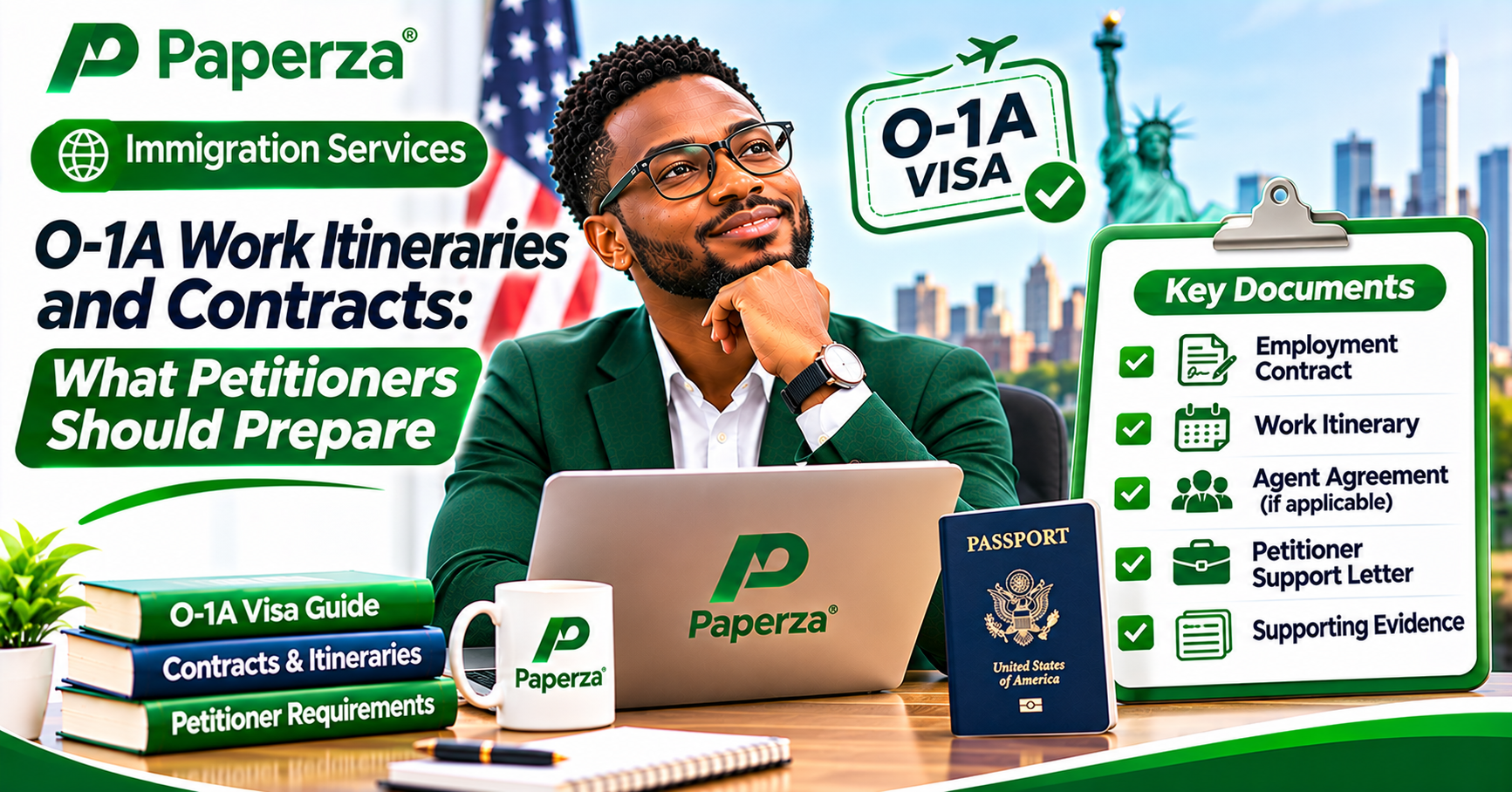
The O-1A visa provides an opportunity for individuals with extraordinary ability in science, education, business, and athletics to work temporarily in the United States.
While professional achievements, research publications, awards, and industry recognition are important components of an O-1A petition, applicants must also demonstrate that they have legitimate professional activities planned in the United States.
Employment contracts, work itineraries, engagement agreements, and petitioner documentation help establish the nature of the proposed work and the relationship between the beneficiary and the petitioning organisation.
Even a highly accomplished professional may encounter difficulties if the proposed employment arrangements are inadequately documented.
This guide explains what O-1A petitioners should prepare, how work itineraries and contracts are structured, and common mistakes to avoid.
Professionals preparing their career documentation can explore Immigration Services on Paperza.
What Is an O-1A Work Itinerary?
An O-1A work itinerary is a document describing the professional activities a beneficiary intends to undertake in the United States during the requested petition validity period.
Depending on the employment arrangement, it may identify projects, consulting engagements, research activities, business responsibilities, conferences, and other professional services.
The itinerary helps United States Citizenship and Immigration Services (USCIS) understand the purpose, duration, and scope of the proposed employment.
A well-prepared itinerary should answer several fundamental questions:
- What work will the beneficiary perform?
- Who will employ or engage the beneficiary?
- Where will the activities take place?
- When will the activities begin and end?
- How does the proposed work relate to the beneficiary's area of extraordinary ability?
- What supporting agreements establish the legitimacy of the engagements?
The required level of detail depends partly on the petitioner's role and whether the beneficiary will work for one employer or multiple employers.
Why Are Work Itineraries and Contracts Important?
O-1A classification is intended for individuals entering the United States to perform work connected to their professional expertise.
An applicant's previous accomplishments establish their qualifications, while the proposed employment documentation explains what they intend to do in the United States.
These documents serve several purposes.
Establishing Legitimate Employment
Contracts and engagement agreements help demonstrate that the beneficiary has genuine professional opportunities rather than speculative employment plans.
Explaining the Proposed Activities
A work itinerary describes the projects, responsibilities, and professional services associated with the petition.
Supporting the Requested Validity Period
The duration of the proposed activities helps USCIS determine the appropriate petition validity period.
Demonstrating the Petitioner-Beneficiary Relationship
Employment agreements and agency authorisations explain how the petitioner is connected to the beneficiary and other participating organisations.
Connecting Future Work to Extraordinary Ability
The proposed activities should relate to the field in which the beneficiary has demonstrated extraordinary ability.
For example, an AI engineer with recognised achievements in machine learning may propose research, software development, technical consulting, and AI product development activities.
Who Can File an O-1A Petition?
An O-1A beneficiary cannot directly self-petition as an individual.
However, several legitimate petitioner arrangements are available.
| Petitioner Type | Description |
| U.S. employer | A United States organisation directly employing the beneficiary |
| U.S. agent acting as employer | An agent engaging the beneficiary under an employment arrangement |
| U.S. agent representing multiple employers | An authorised agent coordinating documented engagements |
| Foreign employer through a U.S. agent | An overseas employer using an authorised U.S. representative |
| Beneficiary-owned U.S. company | A separate legal entity owned by the beneficiary that qualifies to petition |
Each arrangement has different documentation considerations.
The petitioner must establish a legitimate relationship with the beneficiary and demonstrate that the proposed employment satisfies the applicable immigration requirements.
O-1A Employer Petition vs. Agent Petition
Understanding the difference between an employer petition and an agent petition is important when preparing contracts and itineraries.
Direct Employer Petition
A direct employer petition generally involves a United States organisation hiring the beneficiary for a specific position or defined professional activities.
For example, a technology company may hire an AI research scientist to develop machine learning systems over a two-year period.
The employer can document the proposed work through an employment agreement, job description, project information, and supporting explanation.
Agent Petition
An agent petition may be appropriate when the beneficiary has multiple professional engagements or when an authorised representative files on behalf of an employer.
For example, a cybersecurity specialist may have consulting engagements with several United States companies.
An eligible U.S. agent may coordinate these engagements and file the petition with the required supporting documentation.
| Factor | Direct Employer Petition | Agent Petition |
| Employment arrangement | Direct employment | Depends on the agent's role |
| Contract documentation | Employer-beneficiary agreement | Agency and employment agreements as applicable |
| Work itinerary | Proposed employment activities | Detailed engagement schedule where required |
| Multiple employers | Separate petitions generally required unless properly covered by an agent petition | Multiple documented employers may be included |
| Additional documentation | Employment and company records | Agent authorisation and engagement records |
An agent petition does not provide unrestricted permission to work for any employer.
The beneficiary's employment must remain within the scope of the authorised petition and applicable immigration rules.
What Should an O-1A Employment Contract Include?
An employment contract establishes the terms under which the beneficiary will perform professional services.
Although contract structures vary, petitioners should ensure that the agreement clearly describes the actual employment arrangement.
1. Identification of the Parties
Include the legal names of the employer or contracting entity and the beneficiary.
Where appropriate, identify the organisation's business address and authorised representative.
2. Professional Position or Engagement
Describe the beneficiary's position, professional role, or contracted services.
For example:
- Artificial Intelligence Research Scientist.
- Senior Cloud Solutions Architect.
- Cybersecurity Consultant.
- Principal Data Engineer.
- Research and Development Director.
- Technology Product Strategist.
3. Scope of Work
Explain the duties, responsibilities, and expected professional activities.
Avoid relying entirely on generic job descriptions that provide little information about the actual engagement.
4. Employment Duration
Specify the anticipated beginning and ending dates or other applicable duration terms.
These details should be consistent with the requested petition period and supporting work itinerary.
5. Compensation
Document the agreed salary, consulting fee, project payment, or other compensation arrangement.
The compensation information should accurately reflect the genuine agreement between the parties.
6. Work Location
Identify the location where the beneficiary will perform the services.
Where remote or hybrid work is involved, explain the actual arrangement and relevant United States work locations.
7. Employment Conditions
Include relevant conditions such as working hours, deliverables, reporting arrangements, payment schedules, and termination provisions.
8. Agreement Confirmation
Written contracts should clearly establish the parties' acceptance of the employment terms.
Appropriate signatures, dates, and supporting correspondence can help demonstrate the authenticity of the agreement.
Are Written Contracts Mandatory for O-1A Petitions?
The regulations permit petitioners to submit a written agreement or, where no written agreement exists, a summary of the actual oral employment agreement.
An oral agreement summary should accurately describe the terms offered and accepted by the relevant parties.
Supporting documentation may include genuine email correspondence, offer communications, engagement confirmations, and other records demonstrating the agreement.
However, specific agent arrangements have additional contractual requirements.
Petitioners should consult an experienced U.S. immigration attorney to determine which documentation is appropriate for their circumstances.
An unsigned draft or speculative business proposal should not be represented as an accepted employment agreement.
What Should an O-1A Work Itinerary Include?
There is no universal itinerary template suitable for every O-1A petition.
Nevertheless, an effective itinerary should clearly explain the proposed professional activities and their timing.
| Information | Purpose |
| Beneficiary's name | Identifies the professional performing the work |
| Petitioner's name | Identifies the filing organisation or agent |
| Employer or client | Establishes the entity receiving the services |
| Project or engagement | Describes the proposed activity |
| Start date | Identifies the anticipated beginning |
| End date | Establishes the expected duration |
| Work location | Identifies where services will be performed |
| Professional responsibilities | Explains the beneficiary's duties |
| Supporting agreement | Connects the activity to documented employment |
For agent petitions involving multiple employers, the itinerary must provide the engagement dates, employer names and addresses, and actual worksite or venue names and addresses.
The supporting contracts should establish the corresponding employment arrangements.
Sample O-1A Work Itinerary for an AI Engineer
Consider a hypothetical AI engineer who has genuine professional engagements with three United States technology companies.
The following table illustrates how the proposed activities might be organised.
| Period | Proposed Activity | Engaging Organisation | Location |
| January–June 2027 | Machine learning infrastructure development | Technology Company A | Austin, Texas |
| July–December 2027 | AI governance implementation | Technology Company B | Atlanta, Georgia |
| January–June 2028 | Enterprise AI model evaluation | Technology Company C | Boston, Massachusetts |
| July–December 2028 | Continued model optimisation | Technology Company C | Boston, Massachusetts |
Each activity would need appropriate supporting documentation.
For a multiple-employer agent petition, the actual submission would also include complete employer and worksite addresses, specific engagement dates, contractual terms, and relevant authorisations.
This example is illustrative only. It does not represent actual employment opportunities or an approved petition.
Sample O-1A Work Plan for a Research Scientist
An academic researcher may pursue O-1A classification through a university, research institute, or technology organisation.
A proposed research work plan could include the following genuine activities:
| Project Stage | Proposed Responsibilities |
| Initial research phase | Review existing research and establish experimental objectives |
| Development phase | Design research methodologies and technical experiments |
| Implementation phase | Conduct experiments and evaluate results |
| Research communication | Prepare manuscripts and present findings |
| Final project phase | Complete technical documentation and deliver research outcomes |
The supporting documentation may include an employment agreement, research appointment letter, project description, funding information, and institutional confirmation.
The work plan should reflect the researcher's actual responsibilities rather than an artificial list of activities created solely for immigration purposes.
Researchers can explore Research & Academic Services on Paperza for assistance organising genuine publications, research achievements, and academic documentation.
O-1A Work Itinerary for Startup Founders
Startup founders may qualify for O-1A classification when they establish extraordinary ability and satisfy the applicable petitioner and employment requirements.
A separate legal entity owned by the beneficiary, such as a corporation or limited liability company, may petition on the beneficiary's behalf.
However, establishing a company does not automatically establish O-1A eligibility.
A founder's proposed work plan may include:
- Developing a digital product.
- Leading technical research and development.
- Managing product innovation.
- Establishing commercial partnerships.
- Implementing technology infrastructure.
- Conducting product testing.
- Managing business expansion activities.
- Developing intellectual property.
The petition should explain how these activities relate to the founder's demonstrated expertise.
Supporting business records may include incorporation documents, genuine business agreements, product documentation, funding records, organisational information, and evidence of planned operations.
The specific documentation depends on the company's circumstances and proposed employment arrangement.
Can an O-1A Beneficiary Work for Multiple Companies?
Yes. O-1A classification can accommodate multiple employers through appropriate petition arrangements.
A qualified U.S. agent may file a petition covering multiple documented employers and professional engagements.
Alternatively, employers may file separate petitions where required.
A multiple-employer agent petition should establish:
- The agent's authority to represent the relevant parties.
- The identity of each employer.
- The actual contractual arrangements.
- The professional activities associated with each engagement.
- The anticipated dates and work locations.
- The relationship between the proposed work and the beneficiary's extraordinary ability.
A beneficiary should not assume that an approved O-1A petition permits unrestricted freelance work.
New engagements and material employment changes may require additional immigration filings.
What Documents Should a U.S. Agent Prepare?
When an agent represents multiple employers, the documentation should establish the agent's legitimate role and authority.
| Document | Purpose |
| Agent-beneficiary agreement | Explains the relationship and applicable terms |
| Employer authorisations | Establishes authority to act for relevant employers |
| Employer-beneficiary contracts | Documents the actual employment engagements |
| Complete work itinerary | Identifies dates, employers and worksites |
| Agent identification records | Establishes the petitioner's identity |
| Engagement confirmations | Supports the authenticity of proposed activities |
| Petition support letter | Explains the overall arrangement |
The precise requirements depend on whether the agent acts as an employer, represents multiple employers, or represents a foreign employer.
A person or organisation should not be presented as an authorised agent without genuine authorisation and a legitimate underlying employment arrangement.
Are Letters of Intent Acceptable for O-1A Petitions?
Letters of intent may provide useful supporting information when they document genuine professional opportunities.
For example, a technology company may issue a letter confirming its intention to engage a specialist for a defined project.
However, the evidentiary value depends on the letter's contents and the underlying employment arrangement.
A vague expression of interest is different from an accepted offer or documented agreement.
A useful engagement letter may identify:
- The engaging organisation.
- The beneficiary's professional role.
- The proposed project.
- The anticipated duration.
- The expected compensation or agreed terms.
- The work location.
- The authorised company representative.
Letters of intent do not automatically replace required contracts.
Petitioners should obtain legal guidance when relying on these documents.
Can an O-1A Itinerary Include Conferences and Speaking Engagements?
Conferences, professional presentations, technical workshops, and industry speaking engagements may form part of a legitimate work plan.
For example, a recognised cybersecurity professional may be invited to present research at an industry conference while undertaking related consulting work.
Relevant supporting documents may include genuine speaker invitations, event programmes, engagement agreements, and organiser correspondence.
However, conference invitations alone may not establish sufficient employment for the entire requested petition period.
Petitioners should distinguish confirmed activities from speculative opportunities and ensure that any proposed services are appropriately covered.
How Long Can an O-1A Work Itinerary Cover?
An initial O-1A petition may be approved for the period necessary to complete the proposed activities, up to three years.
The maximum period is not automatically granted in every case.
USCIS evaluates the proposed work and supporting documentation when determining the appropriate validity period.
For example, a beneficiary with a documented 12-month research appointment may receive a validity period reflecting that engagement.
A professional with legitimate activities spanning three years may request a longer period supported by appropriate documentation.
Extensions to continue or complete the same activities may generally be granted in increments of up to one year.
Petitioners should request a period that accurately reflects the genuine employment arrangements.
Does an O-1A Itinerary Need to Cover Every Working Day?
An itinerary does not ordinarily need to describe every daily task.
A long-term employment arrangement may be documented through an overall description of the position, project phases, and anticipated employment duration.
For multiple-employer agent petitions, more detailed engagement information is required.
The objective is to provide sufficient information about the nature, timing, and location of the proposed work.
Unexplained periods, inconsistent dates, or speculative engagements may create questions about the requested validity period.
How to Connect Proposed Employment With Extraordinary Ability
A persuasive O-1A petition should establish a clear relationship between the beneficiary's recognised achievements and proposed professional activities.
| Previous Achievement | Related Proposed Work |
| AI research publications | Machine learning research and development |
| Cybersecurity patents | Security product innovation |
| Cloud infrastructure achievements | Enterprise cloud architecture |
| Data engineering contributions | Advanced data platform development |
| Recognised business leadership | Technology company strategy and expansion |
| Academic research awards | Scientific research and innovation |
The proposed position does not necessarily need to have the same job title as the beneficiary's previous employment.
However, the activities should remain within the beneficiary's area of extraordinary ability.
Career documentation, technical project records, and genuine professional achievements can help explain this connection.
What Happens if the Employment Arrangement Changes?
Employment circumstances may change after an O-1A petition is approved.
A beneficiary may receive a new employment offer, complete a project earlier than expected, change professional responsibilities, or encounter changes in the petitioner's business operations.
Depending on the circumstances, a new or amended petition may be required.
Examples that warrant legal review include:
- Changing employers.
- Adding a new employer to an agent arrangement.
- Materially changing employment responsibilities.
- Changing the underlying contractual relationship.
- Ending the employment associated with the approved petition.
- Extending the duration of the proposed activities.
Beneficiaries should consult immigration counsel before beginning employment that may fall outside the approved petition.
O-1A Petitioner Document Checklist
Before filing, petitioners should review the complete supporting documentation.
| Document | Purpose |
| Form I-129 and applicable supplement | Requests O-1A classification |
| Petitioner support letter | Explains the petition and proposed employment |
| Employment contract or permitted agreement summary | Establishes employment terms |
| Work itinerary or activity explanation | Describes the proposed professional activities |
| Agent authorisation | Establishes representation where applicable |
| Additional employer agreements | Supports multiple-employer arrangements |
| Advisory consultation | Addresses the applicable consultation requirement |
| Extraordinary ability evidence | Establishes the beneficiary's qualifications |
| Company or organisational records | Supports the petitioner's legitimacy where relevant |
| Certified translations | Supports documents issued in other languages |
The final document package depends on the specific case, current USCIS requirements, and applicable exceptions.
How to Prepare a Strong O-1A Petitioner Support Letter
A petitioner support letter helps explain the proposed employment arrangement and connect the supporting documents.
A well-organised letter may address the following areas.
Petitioner Background
Describe the petitioning organisation, its business activities, and its relationship with the beneficiary.
Beneficiary's Professional Expertise
Summarise the beneficiary's genuine achievements and recognised expertise.
Proposed Employment
Explain the professional position, responsibilities, and intended activities.
Employment Duration
Identify the requested validity period and explain how it relates to the planned work.
Contractual Arrangements
Describe the applicable employment agreements and compensation arrangements.
Connection to Extraordinary Ability
Explain why the proposed activities are relevant to the beneficiary's demonstrated professional expertise.
Supporting Documentation
Identify the documents included to establish the employment arrangement and extraordinary ability.
The support letter should accurately reflect the underlying evidence and be reviewed by the appropriate petitioner and legal representative.
O-1A Work Itinerary Preparation Template
Petitioners can use the following structure to organise genuine employment information before legal review.
Beneficiary name: Full legal name of the professional.
Petitioner name: Legal name of the employer or authorised agent.
Petitioner address: Complete business address.
Professional field: The beneficiary's established area of extraordinary ability.
Requested employment period: Anticipated start and end dates.
Employer or engaging entity: Legal name and complete address.
Project title: Name of the actual project or engagement.
Professional responsibilities: Detailed description of the proposed services.
Work location: Complete address of the relevant worksite or venue.
Engagement dates: Beginning and ending dates.
Compensation: Agreed salary, project fee, or other applicable terms.
Supporting documentation: Reference to the relevant contract, engagement confirmation, or authorisation.
Repeat the engagement information for each applicable employer or project.
This template is an organisational resource, not a substitute for legal advice or required immigration documentation.
Common O-1A Contract and Itinerary Mistakes
1. Submitting Generic Employment Descriptions
Vague statements about future professional activities may fail to explain the actual proposed work.
2. Using Speculative Employment Opportunities
Potential opportunities should not be represented as confirmed engagements when no genuine agreement exists.
3. Providing Inconsistent Employment Dates
Contracts, itineraries, support letters, and petition forms should accurately reflect the same employment arrangements.
4. Omitting Employer and Worksite Information
Incomplete addresses and engagement details may create problems, particularly for multiple-employer agent petitions.
5. Failing to Establish Agent Authorisation
An agent must have appropriate authority to represent the relevant parties.
6. Requesting an Unsupported Three-Year Validity Period
The requested period should be supported by genuine proposed activities.
7. Confusing Professional Achievements With Employment Evidence
Research publications, awards, and professional recognition may support extraordinary ability but do not independently establish future employment.
8. Using Fabricated Contracts
False employment agreements, fictitious companies, invented client engagements, and misleading documentation can have serious immigration consequences.
9. Ignoring Changes After Petition Approval
New employers and material changes to approved employment arrangements may require additional filings.
10. Failing to Obtain Professional Legal Review
O-1A employment arrangements can involve complex immigration requirements. Qualified legal review is particularly valuable for agent petitions, startup founders, and multiple-employer arrangements.
Can Strong Career Evidence Replace an O-1A Work Itinerary?
No. Extraordinary ability evidence and proposed employment documentation serve different purposes.
A beneficiary may have significant research publications, patents, awards, professional memberships, media coverage, or industry recognition.
These achievements may support the extraordinary ability requirements.
However, the petitioner must separately establish the legitimate professional activities the beneficiary intends to undertake in the United States.
An effective petition addresses both areas through consistent and independently verifiable documentation.
Where to Get O-1A Career Documentation Support
Preparing an O-1A petition requires careful organisation of professional achievements, employment records, and supporting evidence.
Paperza provides access to freelance academic and professional documentation services that may help applicants organise their existing achievements.
Relevant services may include:
- Academic CV preparation.
- Research publication documentation.
- Professional portfolio organisation.
- Technical project summaries.
- Research impact documentation.
- Professional achievement summaries.
- Editing and formatting supporting documents.
Explore Immigration Services on Paperza to find relevant professional support.
Petitioners should work with a qualified U.S. immigration attorney or other authorised legal representative for legal strategy, contract suitability, petition preparation, and individual immigration advice.
Frequently Asked Questions
Is a work itinerary required for every O-1A petition?
Petitions must explain the proposed activities and their timing and include applicable itinerary information. Multiple-employer agent petitions have specific detailed itinerary requirements.
Can I apply for an O-1A visa without a U.S. employer?
An eligible U.S. agent may petition under appropriate circumstances, including representing a foreign employer or multiple employers. A legitimate underlying work arrangement is still necessary.
Can my own company sponsor my O-1A visa?
A separate legal entity owned by the beneficiary may file a petition on the beneficiary's behalf, provided the applicable requirements are satisfied.
Do O-1A contracts need to be written?
The general rules permit a summary of a genuine oral agreement where no written contract exists. Specific agent arrangements have additional contract requirements.
Can an O-1A beneficiary work for multiple clients?
Yes, when the employment is appropriately covered by an authorised petition arrangement. O-1A status does not provide unrestricted employment authorisation.
Can I change employers after receiving O-1A approval?
Changing employers generally requires appropriate immigration filings. Beneficiaries should obtain legal advice before beginning new employment.
Does an O-1A itinerary guarantee three years of approval?
No. USCIS determines the validity period based on the proposed activities and supporting documentation, subject to the applicable maximum.
Where can I get help organising my O-1A professional evidence?
Professionals can explore Immigration Services on Paperza for relevant academic and career documentation support.
Conclusion
Work itineraries and employment contracts are important components of an O-1A petition.
While extraordinary ability evidence establishes the beneficiary's professional qualifications, employment documentation explains the legitimate activities they intend to undertake in the United States.
Petitioners should prepare accurate contracts, clearly defined work plans, appropriate authorisations, and supporting records that establish genuine employment arrangements.
Whether the beneficiary is an AI engineer, research scientist, cybersecurity specialist, startup founder, or business executive, the proposed activities should align with their established professional expertise.
A well-organised petition supported by authentic evidence and appropriate legal review can help present a clear and credible case.
Ready to organise your O-1A professional evidence and career documentation?
Explore Immigration Services on Paperza and discover professional support for presenting your genuine career achievements.
Disclaimer: This article provides general educational information and does not constitute legal advice. Individual petition requirements vary, and approval is not guaranteed.
Official references:
CONNECT WITH PAPERZA
Follow our official pages for daily publishing guides, expert advice & updates:


I will i will help you get a springer journal peer review invitation for eb1 eb1a
Are you looking for Springer journal peer review invitations to strengthen your EB1A, EB1, or O1 visa profile? I provide professional assistance to researchers, academics, and...
View Related Service >NEED PROFESSIONAL ASSISTANCE?
I will i will help you get a springer journal peer review invitation for eb1 eb1a
Are you looking for Springer journal peer review invitations to strengthen your EB1A, EB1, or O1 visa profile? I provide professional...
OFFICIAL SOCIAL CHANNELS
Stay connected with Paperza across our verified social profiles: